Knowing your board
By Kent Senatore
Tore Surfboards Hawaii,
North Shore, Oahu
Since the early 80’s, the most popular and best
selling surfboard design has been the high performance
shortboard. But over the last four to five years, things
have changed drastically and these days surfers are
much more open to experimentation and trying different
designs. On an average day at the beach you’ll
see every type of surfboard design under the sun from
fishes to eggs, hybrid fun boards to classic noseriders,
and quads to traditional thrusters.
In an attempt to reduce any confusion among the less
experienced surfers out there or perhaps some of the
diehard shortboard enthusiasts, we've written a short
description on each of the major design groups including
each surfboard's performance characteristics, type of
surf they’re best suited for, and level of experience
required to get the most out of their design.
Please keep in mind that these are only rough guidelines,
and each surfer is different. A few surfers may have
differing opinions on certain board designs that we
suggest for a particular type of wave. Each surfer's
preferences and physical ability vary greatly, just
like the infinite number of surfboard combinations.
The goal of this board guide is to give surfers the
general idea behind each design and help you make a
better choice when deciding which board is best suited
for your needs. Don't forget that keeping your board ding free will maximize your magic board's life. We recommend padded surfboard bags for your entire quiver.
Surfboard Types
Fish
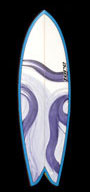 Fishes
are short and wide with flat rocker in the entry and tail.
The Modern Fish, also known as the Rocket Fish have three
fins. Conversely, the traditional fish (circa 1970's) was
designed with twin keel fins. Fish
surfboards catch waves surprisingly well despite their
lack of surface area (most fishes are substantially shorter
than a surfer's normal shortboard), mainly because of its
flatter rocker, allowing the board to plane at a lower speed. Fishes
are short and wide with flat rocker in the entry and tail.
The Modern Fish, also known as the Rocket Fish have three
fins. Conversely, the traditional fish (circa 1970's) was
designed with twin keel fins. Fish
surfboards catch waves surprisingly well despite their
lack of surface area (most fishes are substantially shorter
than a surfer's normal shortboard), mainly because of its
flatter rocker, allowing the board to plane at a lower speed.
The shortness of this design creates a tight turning
radius, making the board better suited to small waves
but the above average surfer can also make them work
in medium size surf as well.
Because of the added width, fish tend to ride flat
on the wave and don’t transition from rail to
rail very well making them difficult to surf vertically.
However, the flat rocker and quick planning make this
a very fast design that loves to race down the line
and fly past slow sections on the wave. The fish is
best for intermediate to advanced surfers.
Eggs
Eggs are similar to fishes in that they have flatter
rocker and plane quickly, allowing them to catch waves
easily. Traditional style eggs have a single fin and
today's modern design utilizes a 2+1 fin setup (large
center fin with two smaller side fins). Adding the side
bites to the longer center fin helps the rider perform
harder rail turns without the fear of spinning out,
which is an inherent drawback of the single fin design.
Eggs also have more curve in their outline than fishes
which equals better turning.
Like fishes, eggs are usually shorter than 6’0”
which makes them best suited for small surf, however,
the above average surfer can adapt and make this design
work in medium size surf as well. Because of the added
curve in their outline, eggs have a smoother rail-to-rail
transition than a fish and love carving big round house
cutbacks. The egg's flat rocker and quick planning ability
create the same speed as fishes and are best suited
for intermediate to advanced surfers.
Shortboards
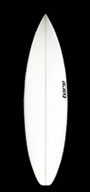 Due
to the highly competitive nature of the shortboard market,
high performance shortboard designs have become very
generic in recent years. Most shapers play follow the
leader, making only subtle changes in bottom contours
and outline to differentiate their designs from one
another. Most surfers lacking a trained eye in board
design will not notice or feel much difference from
one shaper's design to another. Due
to the highly competitive nature of the shortboard market,
high performance shortboard designs have become very
generic in recent years. Most shapers play follow the
leader, making only subtle changes in bottom contours
and outline to differentiate their designs from one
another. Most surfers lacking a trained eye in board
design will not notice or feel much difference from
one shaper's design to another.
Basic shortboard surfboards
feature a single to double concave and three fins (thruster
set-up). These boards are thinned down as much as possible
creating a board that lacks floatation and offering poor
paddling ability. To the novice surfer, shortboards can
be very difficult to catch waves on and unless you’re
a surfer of considerable skill, shortboards prove to be
very difficult to ride in weak/small surf. These boards
are designed for performance minded surfers and are designed
for quality surf.
Shortboards need to be turned continuously to generate
speed and if you posses this kind of ability, you’ll
likely be able to do any type of manuever you can imagine
including airs, tail slides, floaters, reverses, etc.
The shortboard design is definitely meant for the intermediate
to advanced level surfer and will create serious problems
for a beginner.
Retro Single Fins
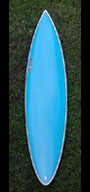 The
retro movement is a product of the previously mentioned
open-minded trend towards experimentation. If you want
to truly understand the history of surfboard design,
it makes perfect sense to try a single fin. Surfing
one will help you see why the advent of the twin fin
and thruster were such significant turning points in
the evolution of surfboard design. The
retro movement is a product of the previously mentioned
open-minded trend towards experimentation. If you want
to truly understand the history of surfboard design,
it makes perfect sense to try a single fin. Surfing
one will help you see why the advent of the twin fin
and thruster were such significant turning points in
the evolution of surfboard design.
The single fin’s template features a wide point
forward of center and the thickest point of a single
fin is also past center. Having more volume under your
chest makes this type of board easy to paddle offering
high wave catching ability. By moving the widest point
forward (which also creates a straighter and narrower
tail), the single fin outline encourages the board to
track down the line. The typical single fin bottom features
vee starting from the center of the board and flowing
to the tail which helps to counter the straightness
of the outline and allow the board to roll from rail
to rail much more freely.
Single fins can work in any size surf but surfer beware,
you'll need to nurse your turns in order to keep the fin
from releasing and causing the dreaded spin out. As mentioned
previously, riding this design will offer you a greater
appreciation of the effortless turning modern surfboard
designs provide. Because of the added volume and ease
of paddling inherent to this design, retro
surfboards can work for a variety of abilities anywhere
from from a total beginner to the more advanced surfer.
Funboards
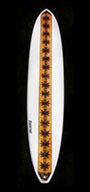 Funboards
are aptly named because they allow the rider to focus
on the purest goal of surfing which is having fun! The
outline is basically an overgrown egg which is why some
shapers call their funboard designs eggs. This type
of board incorporates all the elements of modern surfboard
design including moderate rocker and standard rail shape. Funboards
are aptly named because they allow the rider to focus
on the purest goal of surfing which is having fun! The
outline is basically an overgrown egg which is why some
shapers call their funboard designs eggs. This type
of board incorporates all the elements of modern surfboard
design including moderate rocker and standard rail shape.
Funboards often times utilize thruster fin set ups
and their ample volume and length allow the rider to
paddle, catch waves, and turn effortlessly. Most shapers
will agree that for average surfers, funboards provide
the best of both worlds: the paddling power of a longboard
and the turning ability of a shortboard all blended
into one.
The design works well in small to medium size surf,
however, funboards loose their charm in large surf.
This design is a great all around board that works well
for all surfers but is best suited to the beginner or
the rider making a step down in length from a longboard
towards a shortboard.
Mini Tanker |
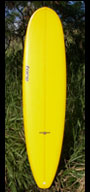 |
This board is for all intents and purposes
a smaller version of the typical longboard. Mini
tankers feature the same design elements as longboards.
Depending on the rider’s preference, mini
tankers can ridden with wide noses and concave
for noseriding, or a pulled in, slightly pointed
nose for a more performance-oriented style of
surfing. Due to the shorter rail line it will
obviously turn quicker than the typical longboard,
yet still paddle and catch waves effortlessly.
These boards will work in any size surf but are
most commonly ridden in small to medium size waves.
The mini tanker's smaller size are best suited
to the weight and body size of women and children
but are often ridden by average sized men as well.
This is another great all around board design
that works well for surfers of any skill level.
|
Longboards
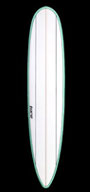 Longboards are loved
and hated by all. If you’re on a longboard, you love
riding them. However, If you're on a shortboard, chances
are you’ll hate all the longboarders in the line-up.
The truth is, riding a longboard puts you as close to the
roots of surfing as possible. Even hot-dogging, the earliest
version of high performance surfing style began on boards
over nine feet long.
Longboards are loved
and hated by all. If you’re on a longboard, you love
riding them. However, If you're on a shortboard, chances
are you’ll hate all the longboarders in the line-up.
The truth is, riding a longboard puts you as close to the
roots of surfing as possible. Even hot-dogging, the earliest
version of high performance surfing style began on boards
over nine feet long.
On a board that catches any wave with ease, you’ll
increase your wave count and learn, or relearn, depending
on your background to appreciate the simple joy of riding
a wave. Just try not to get too greedy when surfing
in a mixed line-up. Because of it’s length, width,
and thickness, the longboard is often referred to as
tanks or tankers. Ironically, these are design attributes
that allow any rider the ultimate in paddling ease and
stability, making them the best beginner boards available.
Depending on the type of surf and how the board is ridden,
longboards feature a variety of fin setups from a single
fin, 2+1, or thruster fin set up.
The longboard's straight rail line makes it trim effortlessly
down the line but requires strength and good technique
to perform. Noserider longboards are usually thick and
bulky with concave in the nose while high performance
designs are thinner with more rocker in the nose and
tail. High performance longboards at times also utilize
a concaved nose for increased nose riding ability. Most
longboard bottoms utilize vee, blending from the center
and flowing off the tail while some high performance
models offer vee with concave running through it for
added speed. Longboards work in any size wave and for
surfers of any skill level including rank beginners
to life long veterans.
Semi-guns |
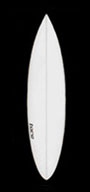 |
Semi-guns or mini-guns are sleek, elegant,
and beautifully foiled boards. Meant to be ridden
in medium to large surf, they’re highly
specialized and are usually designed with a particular
type of wave or a particular spot in mind, i.e.,
'Pipe board' (semi-guns used at the Banzai Pipeline).
Because semi-guns are so surf spot and rider specific,
we won’t get too deep into design characteristics.
Semi-guns fill the gap between shortboards and
guns and are basically a longer and beefier shortboard
while maintaining most of the same design elements.
The outlines of a semi-gun is slightly wider and
the thicker, often by 1/8” to 3/16”.
We recommend that each surfer work closely with
your shaper to develop a board suited to your
specific surfing needs. Semi-guns are for the
advanced to expert level surfer. |
Guns
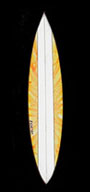 Guns
are serious boards for the serious surfer and are designed
for riding the largest days of the year. Chances are
if you need this type of board you're probably not going
to be reading this but for the sake of education, we’ll
describe them briefly. You can think of guns as a survival
tool rather than a performance design because only the
best of the best do anything more than just survive
the giants waves ridden on these boards. Guns
are serious boards for the serious surfer and are designed
for riding the largest days of the year. Chances are
if you need this type of board you're probably not going
to be reading this but for the sake of education, we’ll
describe them briefly. You can think of guns as a survival
tool rather than a performance design because only the
best of the best do anything more than just survive
the giants waves ridden on these boards.
The objective in big wave surfing is to get into the
wave early, get down the face, and make the wave. Consequently,
these boards have vee bottoms which creates suction
and control, in effect holding you on to the face of
the wave. The last thing a surfer wants on a large wave
is to spin out at the bottom of a twenty or thirty-foot
wave.
Gun surfboards need to be thick
with the wide point slightly forward of center for maximum
paddling efficiency and cover a lot of ground in a short
time. Guns are normally thrusters or single fins, but
recently the four fin has become a viable option as well.
This type of board is for the advanced or expert surfer
only.
Surfer/Shaper Kent Senatore of Tore Surfboards
Hawaii has been making custom
surfboards since 1980 and has an impressive resume.
He has a proven track record and a unique ability to
connect on a personal level with every customer. Kent's
commitment to quality, attention to detail, and personal
service are guaranteed to improve your surfing experience
on every level.
Related articles
A Beginner's Basic
on Surfboard Designs
Board design for
more advanced surfers
Surfboard History
Surfboard Reviews
More surfing tips
back to top |